





A child melts down because someone took the red crayon. Another hides behind a teacher at drop-off. A third wants desperately to join play but does not know how to ask. That is where a preschool social emotional learning guide becomes so helpful. In my years as an educator, I learned that young children rarely need a long lecture. They need calm adults, simple language, repeated practice, and plenty of chances to feel successful.
I believe social-emotional learning in preschool is not an extra lesson you squeeze in after circle time. It is the work of early childhood. When children learn how to name feelings, wait for a turn, repair a mistake, and notice how someone else feels, they are building the foundation for reading, learning, friendships, and classroom confidence.
What preschool social emotional learning really looks like
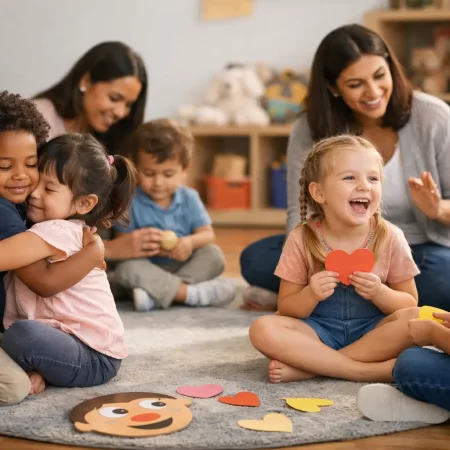
Parents and teachers sometimes hear the phrase and picture a formal program. In real life, preschool social emotional learning looks much simpler and much more human. It is a child learning to say, “I am mad,” instead of hitting. It is taking a deep breath before trying again. It is noticing a friend is sad and offering a toy, a pat, or a kind word.
I have seen over and over that children do best when these skills are taught in everyday moments. Snack time teaches patience. Cleanup teaches responsibility. Story time teaches empathy. Playground conflicts teach problem-solving. None of this is perfect or tidy, and that is part of the process.
There is also a trade-off adults should understand. We want to support children without stepping in too fast. If we solve every small social problem for them, they do not get enough practice. If we leave them on their own too often, frustration grows. The sweet spot is gentle coaching.
A preschool social emotional learning guide for everyday routines
I always tell families and educators to start with routines because routines make children feel safe. When children know what comes next, they have more energy for learning and connecting.
Start with feelings words
Very young children often act out what they cannot yet say. I believe one of the kindest things we can do is give them simple words for big feelings. Try words like happy, sad, mad, worried, excited, frustrated, and proud. Keep it natural. You might say, “Your tower fell. That feels frustrating,” or, “You look proud of how you zipped your coat.”
This does not mean every feeling needs a long discussion. Sometimes one calm sentence is enough. Over time, children begin to borrow our language. That is a real step toward self-control.
Use visual and verbal routines
Preschoolers thrive on predictable patterns. A simple picture schedule, a cleanup song, or a consistent goodbye routine can prevent many struggles before they start. I learned in special education and general education settings alike that predictability lowers confusion and helps children feel capable.
If transitions are hard, narrate what is coming next. “Two more turns, then we wash hands.” “After books, we line up.” That little bit of preparation can make a big difference.
Teach calming before children need it
A child in the middle of a meltdown is usually not ready for a lesson. Practice calming tools during peaceful times. Breathe in like smelling a flower and blow out like cooling soup. Squeeze hands tight and let go. Hug a stuffed animal. Sit in a cozy quiet space for a minute.
What works depends on the child. Some children need movement. Others need closeness. Some need space. I encourage adults to notice patterns instead of expecting one strategy to fit every child.
Coach friendship skills directly
Many preschoolers want friends but do not yet know how to enter play, share ideas, or handle disappointment. We have to teach those skills clearly. Model short phrases such as “Can I play too?” “When you are done, may I have a turn?” and “I do not like that.”
I also believe books are a gentle way to open these conversations. In Dilly Duck Plays All Day, children can see friendship and playful interaction in a way that feels warm and inviting. Stories help children practice emotionally from a safe distance, which is often easier than doing it in the heat of the moment.
What adults can say in hard moments
When a child is upset, our words matter. I try to keep language short, calm, and clear. Too many words can feel like noise to a distressed child.
You might say, “You are upset. I am here.” Or, “You wanted the truck. Let us find a way to solve it.” Or, “It is okay to feel mad. It is not okay to hit.” Those kinds of responses offer comfort and boundaries at the same time.
I believe that balance is essential. Children need warmth, but they also need limits they can trust. Being kind does not mean allowing hurtful behavior. It means helping children through it without shame.
Why stories are such powerful SEL tools
As a children’s author, I have always believed stories can reach places direct instruction cannot. A good story gives children a safe place to practice big feelings. They see characters struggle, make mistakes, apologize, include someone, try again, and discover that they are still loved and accepted along the way.
That is one reason I created Dilly Duck Plans a Parade. When Billy Beaver sees the world differently from his friends, Dilly and the others learn an important lesson: understanding comes before helping. Through kindness, patience, and teamwork, children discover that our differences are not problems to solve. They are part of what makes every friend special.
A story can open the door to simple but powerful questions like, “How do you think that character felt?” or “What could a friend do next?” Those small conversations build empathy, perspective-taking, and emotional understanding over time.
For children coping with grief or a deep loss, social-emotional learning looks a little different. In those tender moments, children need honesty, comfort, and permission to feel many things at once.
When my son Joseph and I wrote Roy the Koi: The Fish Who Lived Forever, we wanted to share a story about more than saying goodbye. We wanted to remind children and adults that love does not disappear when someone is gone. The stories we tell and the memories we share are part of how we keep those connections alive.
Common mistakes well-meaning adults make
I say this with great compassion because I have made some of these mistakes too. We sometimes expect preschoolers to have more self-control than their brains can manage. We sometimes push apologies before a child understands the harm done. We sometimes say, “Use your words,” without teaching what those words should be.
Another common mistake is treating every conflict like bad behavior. Sometimes a child is hungry, tired, overwhelmed by noise, or unsure how to join in. The behavior still needs guidance, of course, but the response should fit the reason.
I also encourage adults not to rush children past feelings. If a child is disappointed, it is okay for that feeling to be present. Our job is not to erase every hard emotion. Our job is to help children move through it safely.
How parents and teachers can work together
Children do best when the adults in their lives use similar language and expectations. That does not mean home and school need to look identical. It simply means a child benefits from hearing the same core messages in both places.
If you are a parent, ask what phrases your child’s teacher uses for problem-solving or calming. If you are a teacher, share a few simple scripts families can try at home. When adults say things like “Take a breath,” “Use kind hands,” and “Let us solve the problem together,” children begin to internalize those patterns.
I have seen this consistency change a child’s confidence. When children know the adults around them understand them and believe they can grow, they begin to believe it too.
When to be patient and when to look closer
Development is uneven in the preschool years. One child may speak beautifully but struggle with turn-taking. Another may be loving and social but fall apart during transitions. That range can be normal.
Still, I believe adults should pay attention if a child is persistently unable to recover from small frustrations, shows very limited interest in connecting with others, or becomes upset so often that daily life feels hard most days. Curiosity is better than panic. Start by observing patterns and speaking with trusted educators or professionals if concerns continue.
A helpful closing thought I carry with me is this: preschoolers are not giving us a hard time, they are often having a hard time. When we respond with steady guidance, simple language, and genuine warmth, we teach children that feelings can be managed, friendships can be repaired, and mistakes are part of learning. Those are lessons that stay with them far beyond preschool.
From My Bookshelf 📚
As an educator and children’s author, I know children learn best when they are curious, connected, and having fun. That belief inspires every book I write.
Explore my award-winning children’s books, playful learning activities, and free resources for families and educators at:
www.bookchatterpress.com Stories that teach. Characters that care. Learning that feels like fun.