





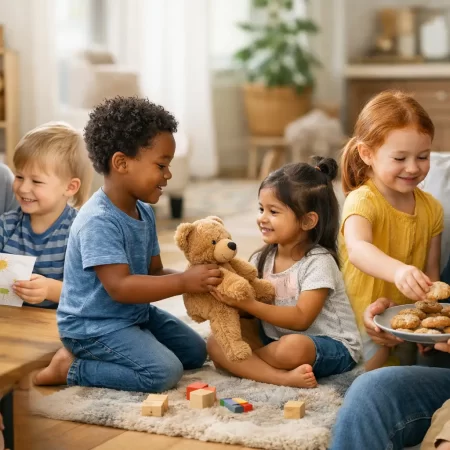
Some of the most meaningful kindness lessons happen in the middle of ordinary family life – when a child offers the last cracker, pats a crying sibling, or helps pick up blocks without being asked. That is why I love preschool kindness activities at home. They do not need to be fancy, and they work best when they feel like part of the day instead of one more thing to manage.
In my years as an educator, I learned that preschoolers understand kindness through action long before they can explain it with big words. They learn by watching us, repeating simple routines, and hearing language that helps them notice how other people feel. At home, you have the perfect setting for that kind of learning because real life gives children real chances to practice.
Why preschool kindness activities at home matter
I believe kindness is not a single lesson. It is a habit built slowly, through repetition, modeling, and warm guidance. For preschoolers, kindness is deeply connected to early self-control, language, and emotional awareness. A child who can notice, “Daddy looks tired,” or say, “You can have a turn,” is building social skills that will support friendships and school readiness.
This is also where many adults get discouraged. A three- or four-year-old may be sweet one minute and completely unwilling to share the next. That does not mean the lesson is not working. It means your child is still learning. Kindness at this age is inconsistent by nature. I always tell families to look for growth, not perfection.
Start with small, repeatable kindness routines
The best home activities are the ones you can do again and again without much preparation. Preschoolers thrive on predictability, and kindness grows faster when it is woven into routines they already know.
The morning helper job
Choose one simple daily job your child can do for someone else. It might be placing napkins on the table, carrying a diaper, feeding a pet with help, or putting a grandparent’s slippers by the chair. Keep it concrete. When children can see the effect of their action, the lesson sticks.
I like to use clear language such as, “You helped our family,” or “That was kind and useful.” Praise works best when it is specific. A quick “good job” is fine, but naming the act teaches the child what kindness looks like.
The kindness goodbye
Before leaving for school, errands, or bedtime, invite your child to choose one kind gesture. It could be a hug, a wave to a neighbor, a thank-you, or drawing a tiny picture for someone. This gives children a gentle ritual that says, “Kindness is something we do on purpose.”
If your child resists, keep it light. Some children love public affection, while others prefer a quiet action. It depends on personality, and that is perfectly fine.
Use play to teach empathy
Play is where preschoolers sort out the world. If you want kindness to make sense, bring it into pretend play, dolls, stuffed animals, and everyday toys.
Care play with dolls and stuffed animals
Set up a simple scenario. A teddy bear is sad. A doll fell down. A toy puppy is hungry. Then ask, “What could we do to help?” You are not looking for the perfect answer. You are helping your child practice noticing a need and responding.
This kind of play is especially helpful for children who are still finding words for feelings. They may not say, “I feel left out,” but they can often show a toy being lonely and then offer comfort. That is real emotional learning.
Turn-taking games that stay short
Many kindness struggles in preschool come down to waiting and sharing. I suggest short turn-taking games instead of long activities that test patience too far. Roll a ball back and forth, build a block tower one piece at a time, or take turns choosing crayons.
If a child melts down, that is useful information. The skill may still be too hard in that moment. Shorter turns, visual reminders, or adult support can help. Kindness and self-control develop together, and both take time.
Read stories that make kindness visible
Books give children language for what they are living through. I have seen again and again that a warm story can open a conversation that feels much harder in the moment of conflict.
When I read with young children, I pause and ask simple questions such as, “How do you think she feels?” or “What could he do next?” Those little pauses matter. They help children connect actions with feelings.
My own Dilly Duck stories were written with those moments in mind. Dilly Duck Plays All Day gently supports friendship and playful connection, while Dilly Duck Plans a Parade opens the door to talking about empathy, colors, and kindness in ways preschoolers can understand. A story gives children a safe little mirror. They can notice kindness in a character before they are ready to name it in themselves.
Try hands-on preschool kindness activities at home
Some children learn best when their hands are busy. If that sounds like your child, simple kindness projects can work beautifully.
Make a kindness chain
Cut paper strips and each day write or draw one kind act your child did or noticed. It might be “helped clean up,” “shared the blue cup,” or “hugged Grandma when she was sad.” Link the strips into a chain and watch it grow.
I love this activity because it makes kindness visible. Preschoolers need to see progress. A growing chain says, “These small moments count.”
Create a help basket
Fill a small basket with child-safe ways to help, such as tissues, napkins, socks to match, pet toys to put away, or notes with picture cues for simple jobs. When someone in the home needs help, invite your child to choose a task from the basket.
This works especially well for children who want to help but do not know how. Kindness is easier when the path is clear.
Draw thank-you pictures
Preschoolers may not be ready to write full notes, but they can absolutely create meaningful thank-you pictures. After a playdate, visit, or kind gesture from a neighbor or teacher, invite your child to draw what happened. Then add one dictated sentence underneath.
This builds gratitude and early literacy at the same time. I always appreciate activities that support both heart and learning.
Teach the words that support kind behavior
Children cannot always do what they cannot yet say. One of the most helpful things you can do is model short, usable phrases.
I would start with language like, “Are you okay?” “Can I help?” “You can have a turn after me,” and “I made space for you.” Practice these during play, not just during conflict. When children rehearse kind words in calm moments, they can access them more easily later.
This is also a wonderful time to name feelings in simple ways. Try, “She looks disappointed,” “He seems worried,” or “You were proud when you helped.” Emotional vocabulary gives kindness somewhere to land.
Let children see your kindness too
One truth I learned over 35 years is that children notice far more than we think. The way you speak to the cashier, check on a neighbor, thank a bus driver, or comfort a family member becomes part of your child’s understanding of how people treat one another.
You do not need to perform kindness or turn every good deed into a speech. Just let your child witness it. Sometimes I would quietly narrate: “Mrs. Lee sounded tired, so I brought her soup,” or “I am sending this card because kindness helps people feel remembered.” That gentle explanation helps children connect the act with the reason behind it.
When kindness feels forced
There are days when children are hungry, tired, jealous, or overstimulated, and kindness is simply harder. I want to say this clearly to every parent and caregiver reading: do not turn kindness into pressure.
If a child is told to hug, share, apologize, or perform generosity before they are ready, the lesson can lose its heart. I believe it is better to coach than to force. You might say, “You are not ready to give the toy yet. Let us find another way to be kind,” or “Your brother is sad. You do not have to hug him, but you can sit nearby or hand him his blanket.”
That kind of flexibility respects the child while still teaching the value. Kindness is not one-size-fits-all.
Keep preschool kindness activities at home simple and steady
If you try every idea at once, it may start to feel like a project instead of a way of life. I would choose two or three preschool kindness activities at home and repeat them for a few weeks. Children need that steady rhythm. A kindness chain, a helper job, and one empathy-rich read-aloud can be more powerful than ten scattered attempts.
I believe the goal is not to raise a child who says the right words on cue. It is to nurture a child who begins to notice others, respond with care, and understand that even small actions can bring comfort. Those lessons grow slowly, but they grow beautifully.
When you set the table together, read one more story, or help your child carry a snack to someone else, you are doing more than filling time. You are shaping the kind of heart that will one day walk into classrooms, friendships, and communities with gentleness and confidence.
From My Bookshelf 📚
Children will discover why kindness counts to a little beaver with color blindness in my award-winning picture book, Dilly Duck Plans a Parade.
Explore playful learning activities, and free resources for families and educators at:
www.bookchatterpress.com Stories that teach. Characters that care. Learning that feels like fun.