






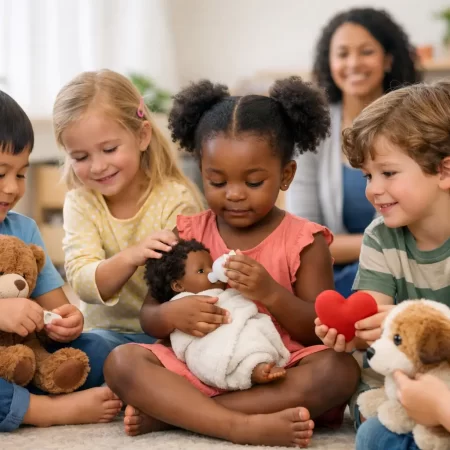
A child grabs a toy, another child bursts into tears, and suddenly the room feels very big and very loud. In moments like that, empathy activities for preschoolers are not just nice extras. They are part of helping young children learn how to live with other people kindly, calmly, and with growing awareness.
In my years as an educator, I learned that empathy does not appear all at once. Preschoolers are still learning that other people have feelings separate from their own. That takes time, practice, repetition, and a great deal of patient modeling from the adults who love them. The good news is that empathy can be nurtured in ordinary moments at home, in preschool, in childcare, and even during story time on the couch.
Why empathy matters so much in the preschool years
I believe empathy is one of the foundations of school readiness, even though it does not always show up on a checklist the way letter names or counting do. A child who can notice, even a little, that a friend is sad, frustrated, left out, or excited is beginning to build the skills that support friendship, problem-solving, and classroom cooperation.
That does not mean preschoolers should be expected to respond with perfect kindness every time. They are impulsive. They are still learning language. They often feel their own emotions in such a big way that it is hard to make room for someone else’s. That is why empathy work at this age should be simple and concrete. We are planting seeds, not demanding polished behavior.
12 empathy activities for preschoolers that really work
1. Use feeling faces during everyday moments
I like to start with pictures of simple facial expressions – happy, sad, mad, surprised, worried, and proud. You can draw them yourself, cut them from magazines, or make them with sticky notes. Ask, “Which face matches how your brother feels?” or “How do you think the little girl in the story feels?”
This works well because preschoolers understand what they can see. Once children notice expressions, they begin connecting faces to feelings and feelings to behavior.
2. Read stories and pause to wonder
Books are one of the gentlest ways to grow empathy. When I read aloud, I do not rush to the end. I pause and ask, “What do you think happened to make him feel that way?” or “What could a friend do right now?”
This is one reason I value stories centered on friendship and kindness. In Dilly Duck Plans a Parade, children can talk about colors, feelings, and how characters care for one another. A story gives children enough distance to think safely, and that often opens the door to deeper understanding.
3. Practice simple role-play
Pretend play gives children a chance to rehearse caring behavior before they need it in real life. I might say, “Your teddy fell down and feels sad. What can we do?” or “Your doll is new to school and feels shy.”
The goal is not performance. The goal is helping children try out the language of comfort, such as “Are you okay?” “Do you want help?” or “You can play with me.”
4. Teach children to notice body language
Many children hear adults say, “Use your words,” but before words come, bodies often speak first. A child with crossed arms, tears, or a turned-away face is telling us something.
I often point this out gently. “Look at his face. He seems upset.” Or, “Her shoulders are tight. I think she may be frustrated.” This helps children understand that feelings are not invisible.
5. Try the “what happened next?” game
This is a favorite in classrooms and around the kitchen table. Start with a short situation: “Maya made a tower. Then someone knocked it over.” Ask your child, “How does Maya feel? What might she do next? What could a friend do?”
Children do not always choose the kindest answer first, and that is fine. Those moments are where the teaching lives. You can guide without shaming by saying, “That is one choice. What is a kinder choice?”
6. Make helping part of the daily routine
Empathy grows through action as much as conversation. Young children feel capable when they help. Ask them to carry a napkin to a sibling, bring a tissue to a friend, or help set out snacks for the group.
These small acts show children that noticing another person’s need can lead to doing something useful. That connection matters.
7. Use mirrors to connect expressions and feelings
Give children a mirror and invite them to make a happy face, a worried face, a disappointed face, and a proud face. Then talk about times people might make those faces.
This sounds simple, but it is powerful. Children begin by understanding their own feelings and expressions. From there, they are more able to recognize those same feelings in others.
8. Name emotions without rushing past them
One of the strongest empathy activities for preschoolers is also one of the quietest. When a child is upset, name what you see with calm, steady language. “You are sad your block tower fell.” “You are mad because you wanted a turn.”
When adults do this consistently, children learn emotional vocabulary. Once they can name feelings in themselves, they are better prepared to recognize feelings in someone else. It is not instant, but it is lasting.
9. Create a classroom or family kindness ritual
I have seen children respond beautifully to simple rituals. You might end the day by asking, “Who helped someone today?” or “What was one kind thing you noticed?” In a classroom, this can happen at circle time. At home, it can happen at dinner or bedtime.
The point is not to praise children into performing kindness. The point is to help them notice that kindness is real, visible, and worth repeating.
10. Care for something together
Children often grow empathy when they care for a plant, a class pet, or even a stuffed animal in pretend play. They begin to think, “What does it need?” That question is at the heart of empathy.
If a child has experienced loss, this kind of care can also open meaningful conversations. When families are navigating grief, I have found that stories can help children feel less alone. Roy the Koi: The Fish Who Lived Forever was written from that tender place of helping children talk about love, loss, and remembering.
11. Model repair after mistakes
Children do not learn empathy because adults talk about it perfectly. They learn it because adults live it honestly. If you snap, miss a cue, or respond impatiently, let your child hear a real apology. “I was frustrated, and I spoke too sharply. I am sorry.”
That teaches two important lessons at once. First, other people have feelings. Second, relationships can be repaired when we take responsibility.
12. Keep it playful, not preachy
Preschoolers learn best through warmth, repetition, and play. Songs, puppets, simple games, and picture books are often more effective than lectures. If a child is already upset, a long talk about kindness usually causes more frustration than growth.
I believe children listen best when they feel safe, connected, and understood. That is when empathy has room to grow.
When empathy activities for preschoolers do not seem to work
This is the part I always want adults to hear clearly – progress can look uneven. A child may comfort a crying friend one day and snatch a toy the next. That does not mean the lessons are failing. It means the child is still learning.
Temperament matters. Language development matters. Sleep, hunger, overstimulation, and changes in routine matter too. Some children show empathy early with words. Others show it first through action, such as patting a back, offering a toy, or sitting nearby. I would not measure empathy only by what a child says.
If your child seems unmoved by someone else’s feelings, start smaller. Focus on noticing expressions, naming emotions, and practicing short scripts. Expecting a four-year-old to fully understand another person’s disappointment in a busy moment may be too much. But expecting that same child to hand over a tissue or say, “You’re sad,” may be just right.
The adult’s role matters most
After 35 years in education, I can tell you this with confidence: children learn empathy by being treated with empathy. When we respond to their big feelings with steadiness instead of shame, they begin to understand what caring feels like. When we narrate what others may be experiencing, they begin to widen their view. When we read stories full of friendship, kindness, and heart, those ideas settle in over time.
If you are a parent, caregiver, grandparent, or teacher, please do not underestimate the power of your tone, your modeling, and your patience. The small moments count. The toy dispute, the scraped knee, the shy child at circle time, the character in a picture book who feels left out – those are the teaching moments children carry with them.
Sometimes the kindest children are not the ones who learned a perfect script. They are the ones who were gently guided again and again until caring became part of how they move through the world.
From My Bookshelf 📚 After 35 years as an educator, I know children learn best when they are curious, connected, and having fun. That belief inspires every book I write.
Explore my award-winning children’s books, playful learning activities, and free resources for families and educators at:
www.bookchatterpress.com Stories that teach. Characters that care. Learning that feels like fun.