




The best read-alouds for young children do more than hold attention for five sweet minutes before bedtime. They invite children to listen closely, predict what comes next, join in with confidence, and feel successful with language. That is why rhyming picture books kindergarten families and teachers choose again and again can become such a powerful part of school readiness.
For children on the edge of kindergarten, rhyme is not just charming. It is useful. A strong rhyming story helps children hear patterns in words, notice sounds, remember phrases, and participate even before they can read independently. When a child gleefully fills in the missing word at the end of a line, that moment is building more than excitement. It is building early literacy.
Why rhyming matters before and during kindergarten
Kindergarten asks a lot of young learners. Children are learning how to listen in a group, follow directions, express their thoughts, and make sense of letters and sounds. Rhyming books support many of those skills at once.
When children hear words like cat, hat, and bat, they begin to notice that words can sound alike in predictable ways. That sound awareness matters because phonological awareness is one of the early foundations for learning to read. A child does not need formal phonics lessons to benefit from rhyme, but repeated exposure to playful word patterns helps prepare the brain for that work.
Rhyming stories also strengthen memory. The rhythm and repetition in a well-written picture book make language easier to hold onto. That is one reason children often ask for the same rhyming book night after night. Familiar language lets them anticipate, participate, and feel capable.
There is also a social-emotional benefit that adults sometimes overlook. Joining in on a repeated rhyme gives hesitant children a low-pressure way to speak up. For children who are shy, still developing expressive language, or adjusting to classroom routines, that sense of success can be meaningful.
What makes good rhyming picture books for kindergarten
Not every rhyming book works equally well in a kindergarten setting. Some are delightful for one-on-one snuggly reading but less effective for a group. Others have catchy rhyme but a story that feels thin. The strongest choices bring warmth, rhythm, and substance together.
A good kindergarten rhyming picture book has a natural beat. The text should flow smoothly when read aloud, without awkward lines that make adults stumble. If the rhythm feels uneven, children notice. Their attention can drift quickly when the language does not carry them forward.
Strong rhyme should also support meaning, not distract from it. Sometimes a book forces unusual word choices just to make the rhyme work. Young children benefit most when the language feels clear and conversational, even while it is musical.
The illustrations matter too. Kindergarteners rely heavily on pictures to build comprehension. In the best books, the art helps children predict, infer, laugh, and connect the words to a bigger idea. A rhyming text with engaging illustrations becomes easier to discuss, act out, and remember.
Finally, the most useful books offer something beyond sound play alone. They may build counting skills, introduce social-emotional themes, support vocabulary, or reinforce routines children will encounter in school. Entertainment matters, but purpose matters too.
How rhyming books support kindergarten readiness
Parents and teachers often ask which books truly help children get ready for school. The answer depends on the child, but rhyme is one of the most practical places to start because it supports several readiness areas at once.
Early literacy and phonological awareness
Rhyming stories help children listen for ending sounds, compare words, and begin to hear that language can be broken into parts. Those are early skills that come before fluent reading. A child who notices that star and car sound alike is practicing an important kind of listening.
This does not mean every rhyming book automatically builds literacy in a deep way. Some books are better for enjoyment than instruction, and that is perfectly fine. But when adults pause, reread, and invite children to listen for matching sounds, a simple story can become a strong early learning moment.
Vocabulary and oral language
Picture books expose children to words they may not hear in everyday conversation. In rhyming texts, those words often become easier to remember because they are tied to a pattern. Children may not use a new word right away, but repeated read-alouds make language more familiar and accessible.
Books with playful, expressive language can also encourage children to tell stories, retell events, and ask questions. That oral language growth matters in kindergarten, where children are expected to share ideas, answer prompts, and participate in group discussions.
Confidence and participation
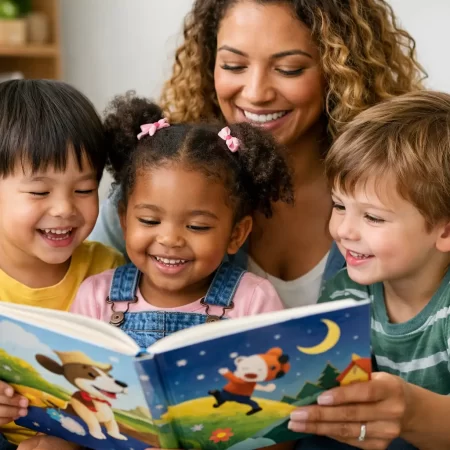
One of the loveliest things about rhyme is how quickly it invites children in. Even children who are not yet ready to sit through a long story often perk up when they hear predictable text. They can clap the beat, finish a line, or echo a phrase.
That active participation helps build confidence. A child who feels successful during story time is more likely to stay engaged, try again, and see books as a place of joy rather than pressure.
How to choose the right rhyming books for your child or classroom
Age labels can only tell you so much. A book marked for ages four to eight may be perfect for one kindergartener and too busy for another. The best choice depends on attention span, language development, interests, and setting.
If you are reading at home, think about connection first. Choose books your child wants to hear more than once. Repetition is not a problem. It is often where the learning settles in. A child who requests the same rhyming story every night is practicing memory, language, and comprehension with each reading.
If you are choosing for a classroom, group dynamics matter. Look for books with a strong read-aloud rhythm, expressive illustrations, and opportunities for call-and-response. Stories with repeated refrains work especially well during circle time because they let children participate without needing to know every word.
It also helps to balance fun with function. Some rhyming books are wonderfully silly and should stay in the rotation for pure delight. Others can support specific goals such as counting, kindness, emotional vocabulary, or classroom behavior. A thoughtful mix serves children best.
Simple ways to make rhyming picture books more interactive
You do not need a formal lesson plan to help children learn from rhyme. A few gentle prompts can turn reading time into meaningful practice without taking away the joy of the story.
Before turning the page, pause and let children guess the rhyming word. If the text says, “I see a fox in bright red…” many children will happily call out “socks.” Even when they guess wrong, they are listening for sound patterns.
You can also repeat favorite rhyming pairs after the story ends. Say two words and ask whether they rhyme. Then invite children to think of a new word that sounds similar, even if it is a silly nonsense word. Playfulness helps learning stick.
Movement adds another helpful layer. Clapping the rhythm of a repeated phrase, tapping for syllables, or acting out key story moments can help active learners stay engaged. For many children, especially those who learn best through movement and repetition, this makes story time more successful.
When a book includes themes like friendship, kindness, or perseverance, take a minute to connect the story to real life. Ask a simple question such as, “When did you help a friend today?” A strong picture book supports both literacy and heart.
A gentle word of caution about rhyme
Rhyming books are valuable, but they are not all created with the same care. Adults sometimes assume that if a text rhymes, it must be easy for children to follow. In reality, awkward rhyme can confuse meaning and interrupt comprehension.
It is worth reading a book aloud to yourself before sharing it with a group. If the rhythm trips you up or the word choices feel forced, children may struggle to stay with the story. Smooth, natural language is especially important for young listeners who are still building attention and understanding.
It also helps to remember that rhyme is one tool, not the only tool. Some children adore patterned, musical books right away. Others connect more strongly to straightforward stories, nonfiction picture books, or books with repetitive prose rather than rhyme. It depends on the child, and that is perfectly normal.
Why these books stay with children
The rhyming stories children remember most are usually the ones that made them feel something at the same time they were learning something. Maybe they laughed. Maybe they felt calm and close during a bedtime read-aloud. Maybe they proudly shouted out the final word on every page and felt, for a moment, completely sure of themselves.
That is part of what makes thoughtfully chosen rhyming picture books so valuable in the kindergarten years. They meet children where they are, with rhythm, warmth, and invitation. At Book Chatter Press, that child-centered blend of joy and readiness is exactly what makes a book worth returning to.
If you are building a home library or refreshing a classroom shelf, choose rhyming books that sound good in your mouth, feel good in a child’s hands, and leave a little room for wonder after the last page.