






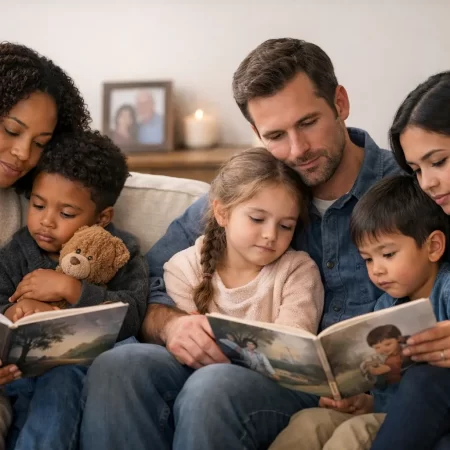
Some of the hardest read-alouds happen when the room is quiet, a child is watching your face, and everyone knows life has changed.
I care deeply about stories that help families during those moments because I have seen how powerful the right book at the right time can be. In my years as an educator, I learned that children do not need us to have perfect words. They need honest, gentle ones. They need permission to ask questions, share memories, and return to the conversation when they are ready.
Why grief picture books for families matter
Children often understand loss in pieces. One moment they ask a profound question, and the next they want a snack or want to play with blocks. Adults sometimes misread that back-and-forth as not understanding, but I have seen the opposite. Children are processing in small, manageable parts.
That is one reason picture books are so helpful. The short text, familiar rhythm, and comforting routine of sitting together can make room for emotions without overwhelming a child. Families can pause on a page, answer one question, or simply sit in silence. There is no rule that says you must finish the book in one sitting.
I also believe picture books help adults. When you are grieving too, it can be hard to know where to begin. A book gives you a starting place. It can help you say, “This part reminds me of Grandpa,” or “I feel that way sometimes too.” Those simple moments of connection build trust.
What to look for in grief picture books for families
Not every book about loss will fit every child. Age matters, but so does the child’s temperament, the kind of loss, and what your family believes about death and remembrance. Some books are very direct. Others use nature, seasons, or the life cycle of a pet to help children approach the topic more gently.
I usually encourage families and teachers to look for stories that do three things well. First, they tell the truth in language children can understand. Second, they make space for a wide range of feelings, including anger, confusion, relief, and even laughter. Third, they leave room for connection, whether that means remembering, asking questions, or noticing that love continues.
The illustrations matter too. Young children often read the pictures before they fully grasp the words. Soft, expressive artwork can help a child return to a difficult story without feeling scared off by it. If the book feels too intense for your child right now, that does not mean it is a bad book. It may simply not be the right fit yet.
The best books do not force a lesson
As an educator, I always look for books that support a child rather than preach at them. Children can tell when a story is trying too hard to make them feel a certain way. The strongest grief books offer reassurance without pressure. They say, in effect, “You are not alone,” rather than, “Here is how you should feel.”
That distinction matters in classrooms and at home. A child who has experienced a recent loss may need a very different reading experience than a child who is asking general questions about death for the first time.
Choosing the right book for your family
I have seen families feel discouraged when a well-meaning recommendation does not land the way they hoped. Please do not take that as failure. Grief is personal, and book choices are personal too.
If a child has lost a pet, a story centered on a beloved animal may feel most accessible. If the loss involves a grandparent or parent, you may want a book that names family relationships clearly. Some children want direct language like “died.” Others are better able to begin with stories about missing, remembering, and love that stays with us.
For very young children, simpler is often better. They may need one clear idea per reading rather than a story with many emotional layers. Early elementary children can usually handle more nuance and may ask questions that stretch beyond the page. I have learned to welcome those questions, even when I do not have neat answers.
When the loss is fresh
In the early days, I suggest choosing shorter books with calm illustrations and reassuring repetition. Children who are newly grieving may return to the same book night after night. That repetition can be comforting. Familiar pages help children feel a little more steady when everything else feels unfamiliar.
When grief keeps resurfacing
Loss does not move in a straight line, especially for children. A birthday, holiday, class project, or empty chair at a school event can bring the feelings right back. At those times, books can re-open the conversation in a gentle way. You do not have to wait for a child to bring it up first.
Reading grief books in a way that helps
The book matters, but the way we share it matters too. I always tell adults to slow down. You do not need a polished discussion guide. You just need presence.
Before reading, I like to let a child know what kind of story it is. Something simple works well: “This book is about missing someone we love.” That little bit of preparation helps children feel safer.
As you read, pause if the child wants to talk, and keep going if they do not. Some children will point to a picture and tell a memory. Others will listen quietly and process later while drawing or playing. Both responses are perfectly okay.
Afterward, I often invite gentle connection rather than a formal conversation. You might say, “Would you like to tell me something you remember?” or “Should we draw a picture for Nana?” In a classroom, it may be enough to offer paper, crayons, and a calm corner. Children often reveal what they are holding through play and art before they can say it out loud.
A book written from the heart
When my son Joseph and I wrote Roy the Koi: The Fish Who Lived Forever, it began with the story of a very real and very special fish. But as we wrote, we realized Roy’s story was about something much bigger.
It was about the way love continues through the stories we tell.
Children often wonder what it means when someone or something they love is gone. They may ask the same questions again and again, not because they were not listening, but because they are trying to understand something very big.
My hope is that Roy gives families a gentle place to begin those conversations. A place where sadness is welcome, memories are celebrated, and children are reminded that the ones we love continue to be part of our story.
Grief at home and grief in the classroom
Families and educators often support children differently, and that is okay. At home, grief books may become part of bedtime, family stories, or remembrance rituals. In school, the goal is often to provide language, predictability, and care without putting a grieving child on display.
In my years in education, I found that teachers do not need to become counselors to be a steady support. Reading a carefully chosen picture book to the whole class can help normalize feelings and build empathy, especially if a classmate has experienced a loss. The key is to keep the conversation open but never force personal sharing.
For some children, one-on-one reading with a trusted adult is the better choice. It depends on the child, the timing, and the nature of the loss. I always come back to this question: What will help this child feel safe, seen, and gently supported right now?
A gentle closing thought for families
If you are looking for grief picture books for families, I hope you will trust yourself as much as the book list. The right story is not always the most famous one or the most poetic one. Often, it is the one your child asks for again, the one that opens a small honest conversation, or the one that lets you sit close together without needing to fix anything.
I believe books can hold a family through tender seasons. Not by taking grief away, but by reminding children that love, memory, and connection still have a place at the table. Sometimes that is exactly what a child needs most.
From My Bookshelf 📚 After 35 years as an educator, I know stories can do more than teach. They can comfort, connect, and help children understand some of life’s biggest feelings.
Explore my children’s books and family resources at:
www.bookchatterpress.com
Stories that teach. Characters that care. Books that help children feel seen.