






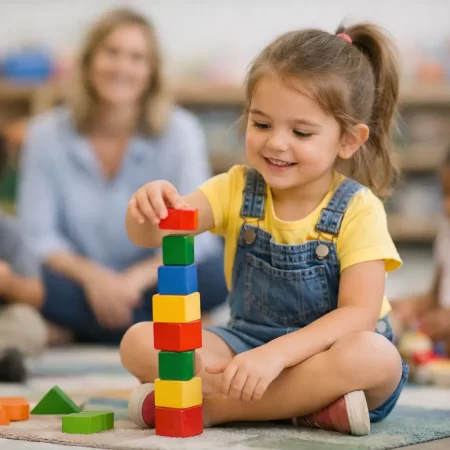
The first day of kindergarten asks a lot of a young child. There are new faces, new routines, shared spaces, directions to follow, and moments that require both courage and flexibility. That is why so many families ask, what is kindergarten readiness? The short answer is this: kindergarten readiness is not about a child doing everything perfectly before school begins. It is about building the foundational skills, confidence, and emotional security that help a child step into the classroom ready to learn.
For some children, that foundation shows up in knowing letters and numbers. For others, it looks more like being able to separate from a caregiver, ask for help, wait for a turn, or sit for a story. Real readiness includes both. Children do best when early academic skills grow alongside language, self-help abilities, social-emotional development, and healthy routines.
What kindergarten readiness really means
Kindergarten readiness is often misunderstood as a checklist of academic tasks. Families may wonder whether a child should already be reading, writing sentences, or completing worksheets. In most cases, that is not the goal. Readiness is better understood as a whole-child picture.
A kindergarten-ready child is developing the ability to participate in a school day. That means listening to simple directions, expressing needs with words, joining group activities, and recovering from small frustrations. It also means showing early literacy and math awareness, such as recognizing some letters, noticing rhymes, counting small sets, or talking about shapes and patterns.
The key word is developing. Readiness is not perfection, and it is not one-size-fits-all. Children grow at different rates. A child may be strong in language but still working on emotional regulation. Another may be socially confident but need more support with pencil grip or letter recognition. That does not mean they are behind. It means readiness is made up of many moving parts.
The skills behind kindergarten readiness
When educators talk about what is kindergarten readiness, they are usually looking across several areas of development rather than focusing on one test or one benchmark.
Social-emotional development
This is one of the biggest pieces of readiness, and often the one that matters most in the early weeks of school. Children benefit from being able to separate from a trusted adult with support, play near or with peers, take turns, and begin to manage feelings in age-appropriate ways.
No four- or five-year-old is expected to stay calm all the time. What helps is when a child is starting to name feelings, accept comfort, and try again after a disappointment. A child who can say, “I need help” or “I feel sad” is bringing an important readiness skill into the classroom.
Language and communication
Kindergarten is filled with language. Children listen to stories, answer questions, follow directions, join conversations, and learn new vocabulary every day. A ready child does not need advanced speech or polished grammar, but it helps if they can express basic needs, understand simple directions, and participate in back-and-forth conversation.
Reading aloud is one of the most powerful ways to build this foundation. Stories grow vocabulary, listening stamina, comprehension, and a love of language all at once. Rhyming books are especially helpful because they strengthen sound awareness, which supports later reading.
Early literacy
Early literacy is not the same as formal reading instruction. Before children read words on a page independently, they build important pre-reading skills. These include recognizing some letters, hearing rhymes, noticing beginning sounds, understanding that print carries meaning, and enjoying books.
A child who pretends to read, turns pages correctly, points to pictures while telling a story, or recognizes their name in print is already building literacy readiness. These small moments matter.
Early math thinking
Kindergarten math starts long before worksheets. Children develop math readiness through everyday experiences like counting crackers, comparing toy sizes, sorting socks by color, or noticing which cup holds more water.
Helpful signs of readiness include counting with growing accuracy, recognizing some numbers, understanding simple concepts like more and less, and noticing shapes, patterns, and quantities. The goal is not speed. The goal is comfort with basic number ideas and curiosity about how things work.
Fine motor and self-help skills
Kindergarten asks children to use their hands in new ways. They may hold crayons, use scissors, open snack containers, zip coats, or wash hands independently. These self-help and fine motor skills support confidence throughout the day.
If a child is still learning these tasks, that is okay. What matters is steady practice. Simple routines at home like drawing, using play dough, stringing beads, buttoning, and cleaning up toys help strengthen both coordination and independence.
What kindergarten readiness is not
It can be comforting to name what readiness does not mean. It does not mean a child has to sit still for long periods without support. It does not mean they must read chapter books, memorize long lists, or behave like a much older child.
It also does not mean every child should hit the same milestones in exactly the same way. Development is uneven by nature. Young children often make big gains in one area while still needing support in another.
This matters because pressure can sometimes get in the way of growth. When learning becomes all drill and no connection, children may start to associate school skills with stress instead of joy. The strongest readiness work usually looks simple from the outside: reading together, talking during errands, playing games, practicing routines, and making space for questions.
How families can support kindergarten readiness at home
The good news is that school readiness does not require a complicated setup. Children learn deeply through repetition, relationship, and meaningful everyday experiences.
Start with routines. Predictable mornings, mealtimes, clean-up habits, and bedtime rhythms help children feel secure. That sense of structure makes the transition to school easier because kindergarten classrooms also run on routine.
Make room for conversation. Ask open-ended questions, listen patiently, and encourage children to describe what they notice, feel, and wonder. Rich conversation builds vocabulary and comprehension in ways flashcards cannot.
Read aloud often, even if it is just for a few minutes. Repeated readings are especially valuable. When children hear a favorite story again, they begin to anticipate language, notice patterns, and join in with confidence. That is one reason so many families and teachers are drawn to playful, rhythmic books with heart. At Book Chatter Press, that connection between story time and skill-building is at the center of what meaningful early learning can be.
Play also deserves more respect in readiness conversations. Through pretend play, children practice language, problem-solving, cooperation, and self-regulation. Through blocks, puzzles, art, and movement, they build the background skills that support classroom learning.
Finally, practice independence in small ways. Let children carry their backpack, put away shoes, open containers, choose between two outfits, or help pack a snack. These little moments send a powerful message: you are capable.
When readiness feels uncertain
Many loving adults worry that a child is not ready yet. Sometimes the concern is about speech, behavior, attention, toileting, fine motor skills, or emotional regulation. Sometimes it is just a feeling that a child seems younger than peers.
That uncertainty deserves thoughtful attention, not panic. If concerns come up, it helps to talk with a preschool teacher, pediatrician, or early childhood specialist who can look at the whole child. Some children simply need more time and practice. Others may benefit from targeted support before or during the kindergarten year.
There is also an important trade-off to keep in mind. Academic exposure can be helpful, but pushing formal skills too early is not always the answer. If a child is overwhelmed, anxious, or resisting every learning activity, the better path may be to step back and strengthen connection, play, language, and routine first.
A more helpful question than “Is my child ready?”
Instead of asking only whether a child is ready for kindergarten, it can be more helpful to ask how we are helping kindergarten feel ready for the child. Readiness grows best when adults respond to who a child is, not just what a checklist says.
Some children walk into school eager to talk to everyone. Others enter quietly and need time to warm up. Some already know many letters. Others are still learning how to take turns in a group. Each child brings strengths. Each child also brings areas that are still unfolding.
The heart of kindergarten readiness is not early perfection. It is steady preparation wrapped in warmth, wonder, and trust. When children feel loved, capable, and supported as they build new skills, they begin school with something even more valuable than a polished performance. They begin with the belief that learning is a place where they belong.